door — A hinged, sliding, or revolving barrier at the entrance to a building, room, or vehicle
Part of speech: NOUN
Definition: A hinged, sliding, or revolving barrier at the entrance to a building, room, or vehicle
Pronunciation (IPA): /dɔːr/
Example Sentences
- I locked myself out because I forgot my keys inside the door.
- The revolving door confused the tourist so much that he went around five times.
- Success requires you to keep knocking on doors until one opens.
door
NOUN[/dɔːr/]
A hinged, sliding, or revolving barrier at the entrance to a building, room, or vehicle
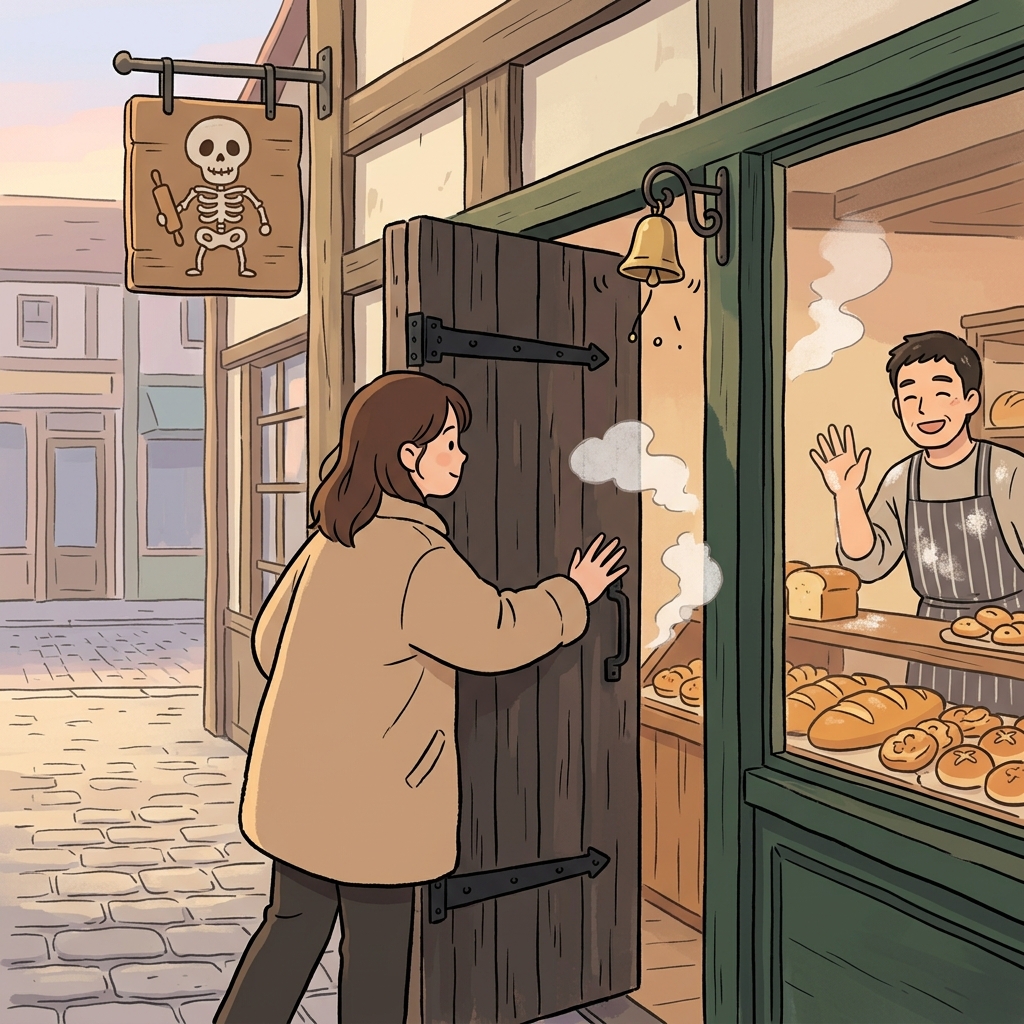
She pushes the heavy wooden door open and steps into the warm bakery.
Got the picture? Now let's practice.
🎤Pronunciation
🌳Etymology
Origin
Door derives from Old English 'duru', a Proto-Germanic word shared with German 'Tür' and related to Proto-Indo-European roots meaning 'opening' or 'passage'. This ancient term emerged alongside human settlement and architecture, reflecting one of humanity's most fundamental architectural concepts.
Breakdown
The word traces a direct phonetic evolution from Old English 'duru' to Modern English 'door', with the final vowel shifting during the Middle English period. The root likely connects to Proto-Germanic '*duraz', ultimately derived from Proto-Indo-European '*dhwer-' (opening, entrance).
🎵Rhyme
🔗Collocations
📝Examples
“I locked myself out because I forgot my keys inside the door.”
“The revolving door confused the tourist so much that he went around five times.”
“Success requires you to keep knocking on doors until one opens.”
“The automatic door refused to open for me - apparently I'm invisible to sensors.”
📚Related Words
Synonyms
Antonyms
Related
Want to master 19,000+ words?
Sign up free for flashcards & quizzes.